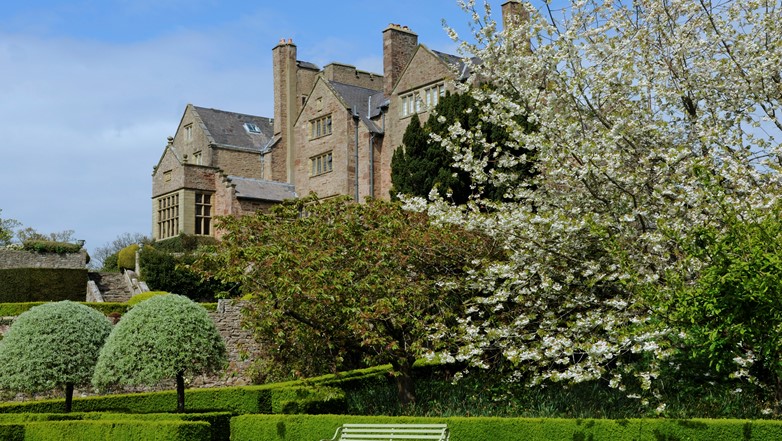

Bodysgallen Hall
Bodysgallen Hall is a Grade I listed house, set in its estate of 220 acres of gardens, parkland and farmland, up on the west of Pydew mountain and two miles south from Llandudno with views to Conwy Castle, Snowdonia and the surrounding countryside. It was originally built in 1250 as an outlying watchtower to Conwy Castle, whilst the rest of the house was built between 1620 and 1900.
The whole house shares a uniform vernacular despite a building history of 600 years. In the gradual addition of one wing and then another, and in the sturdy and conservative style, it is typical of the evolution of the old family houses of Gwynedd.
The key to the origin of the present house at Bodysgallen is the construction of Conwy Castle. This famous fortress was designed to master the wild mountain areas of Snowdonia. It seems beyond doubt that the tower at Bodysgallen was built as a watchtower for Conwy Castle to command the slopes south-west of the low lying castle against surprise attack. The place is first mentioned in the mid-14th Century Record of Caernarvon, as Bodscathlan. While the tower could hardly be claimed as a work of Conwy's master engineer James of St George, the evidence of the masonry of the spiral staircase is that this is indeed a late 13th century tower. It has five storeys, consisting originally of a single room on each floor, with the stair turret on the west angle, against the later chimney from the hall and drawing room. Another link with the castle is that the only known source for the pinkish stone in its window mullions is the quarry in a nearby field. Pink sandstone was used for all the house.
By Elizabethan times Richard Mostyn was the owner of Bodysgallen whilst his elder brother William owned nearby Gloddaeth. Richard had learned Latin and Greek, and collected manuscripts of Welsh literature, and one must assume structures appropriate to his status as a High Sheriff of Caernarvonshire. With the marriage of his daughter Margaret to Hugh Wynn of Berthdu, the house came into the Wynn family, who dominated the Conwy valley. It is the son of this marriage, Robert Wynn, whose initials with that of his wife Katherine appear on the date stone with the year 1620 on the south-west gable.
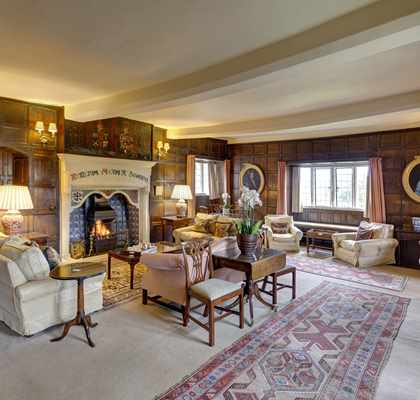
The early 17th century block has five storeys, including attics and cellar, and its austere detailing and mullioned windows set the pattern for all future work at the house. Its two main storeys comprise a large low hall entered at terrace level from the west and an equally large chamber above, wich became the drawing room. Both rooms open in one corner into a curious little bay with windows on two sides and a fireplace on the third; and both have heraldic overmantels. The hall is carved, with the arms of Gruffydd ap Cynan, Wynn and Collwyn. In the drawing room the chimney-breast has on it the Mostyns' motto 'Auxilium Meum a Domino', and above painted on plaster are the arms of Wynn and of the Vaughans of Corsygedol.
These shields date from 17th century Colonel Hugh Wynn, born in 1620, was like his young cousin Colonel Roger Mostyn an ardent Royalist. He held Flint Castle for his cousin the Governor, played a prominent part in defending Chester against Parliamentarian siege, and was one of two hostages specified in the Articles of Surrender on February 3, 1646. He also deserves notice for his protest at Lord Conway's despoliation of Conwy Castle, an operation entailing the removal of the lead and timber from the roofs, so bringing on its ruin.
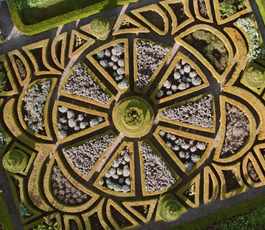
Colonel Hugh's son Robert built further additions to the house, the north-west wing and he or his son Rev Dr Hugh also built the north-east wing dated 1730. The chief work of this period is the gardens. The remarkable parterre is sunk in a deeply-walled rectangle measuring 28yds by 21yds below the south-east side of the house. The large walled rose garden is characteristic of the 18th century in Gwynedd in its attempt to keep plants from the wind. Above it are a complex of terraces and on one is the lily pond.
Four centuries after Bodysgallen was given to Richard Mostyn, Lady Augusta Mostyn enlarged it in 1894 for her second son Henry. The main work consisted of the new drawing room and the taller dining room wing on the south. The stair was modelled on the late-17th century stair at nearby Gloddaeth Hall, and replaced an 18th century one. The stepped gables there and on the drawing room and the little oriel facing south are reminiscent of Plas Mawr; the architect just might have been John Douglas, whom Lady Augusta had employed at Gloddaeth. The porch is contemporary; the tall south wing is a remodelling in 1905 of an 18th century block; and a further addition is of 1914.
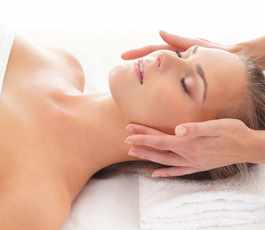
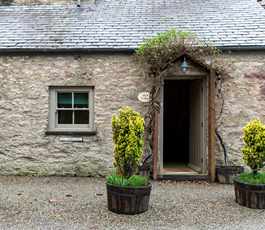
As an hotel it offers fifteen bedrooms in the main hall and sixteen cottage suites nestling in the grounds, meeting rooms, award-winning Spa and a renowned fine dining restaurant and a bistro for casual dining.
For further information please click here to visit the dedicated website